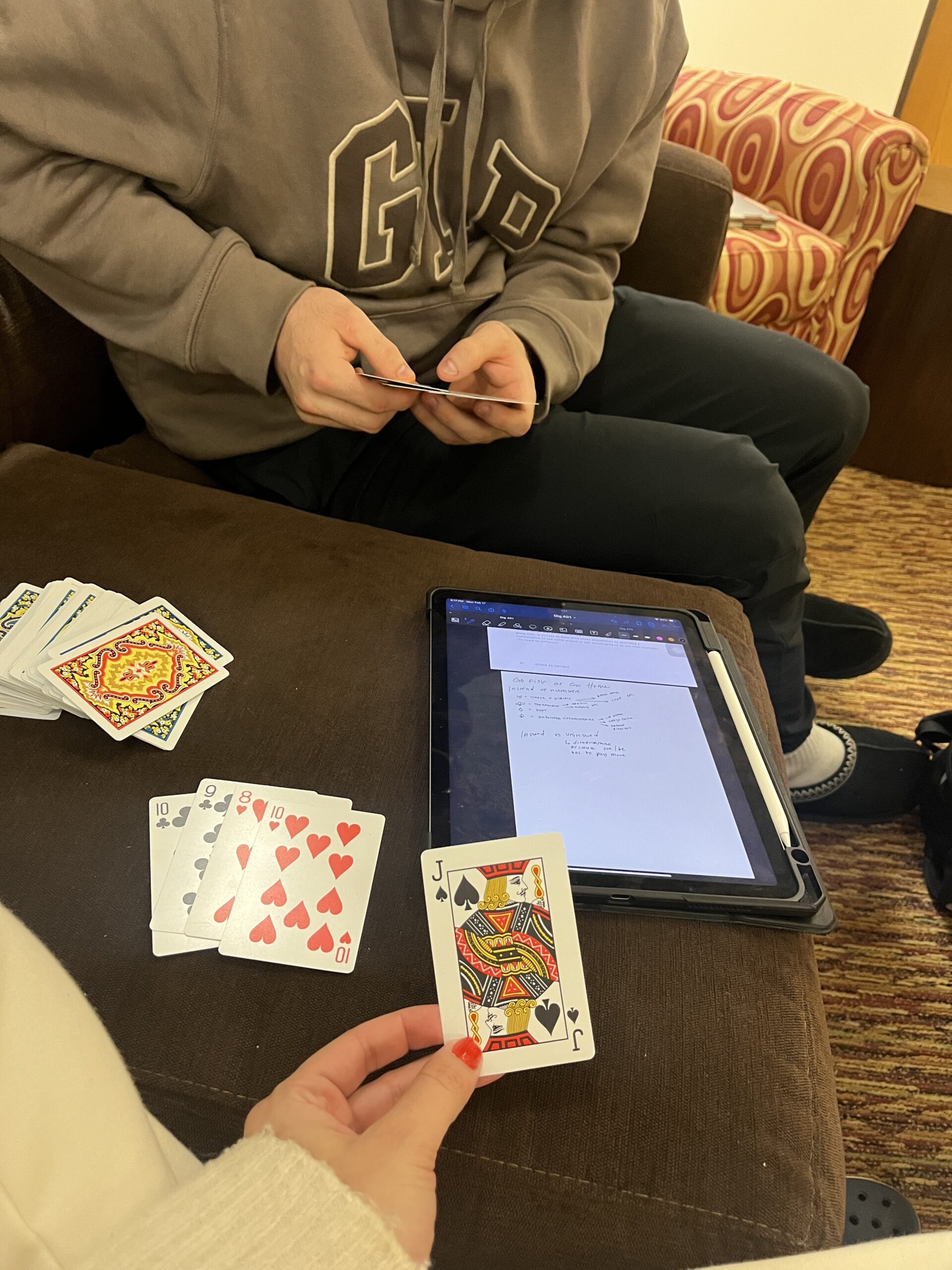
Who doesn’t love Go Fish? And even better—what if we added a twist?
For this hack, my partner, Brett, and I decided to tackle a major inequality—specifically, healthcare disparities in the United States. Our idea for modifying Go Fish was inspired by a concept Dr. Sample mentioned—how a student in his previous class explored Settlers of Catan and how the allocation of resources could relate to conquest, unfairness, and inequality. Additionally, a deck of cards was the only resource we had available, so we worked with what we had!
Our version, Go Fix, is similar to Go Fish but introduces a layer of complexity to reflect healthcare inequalities. Instead of forming “books” of four matching cards, players must pair two related cards: an illness (♥) with its corresponding treatment (♣) while trying to avoid bad luck (♠) cards, which increase costs, and hoping to draw good luck (♦) cards, which provide financial relief. You might be wondering, what does this mean? Let me explain.
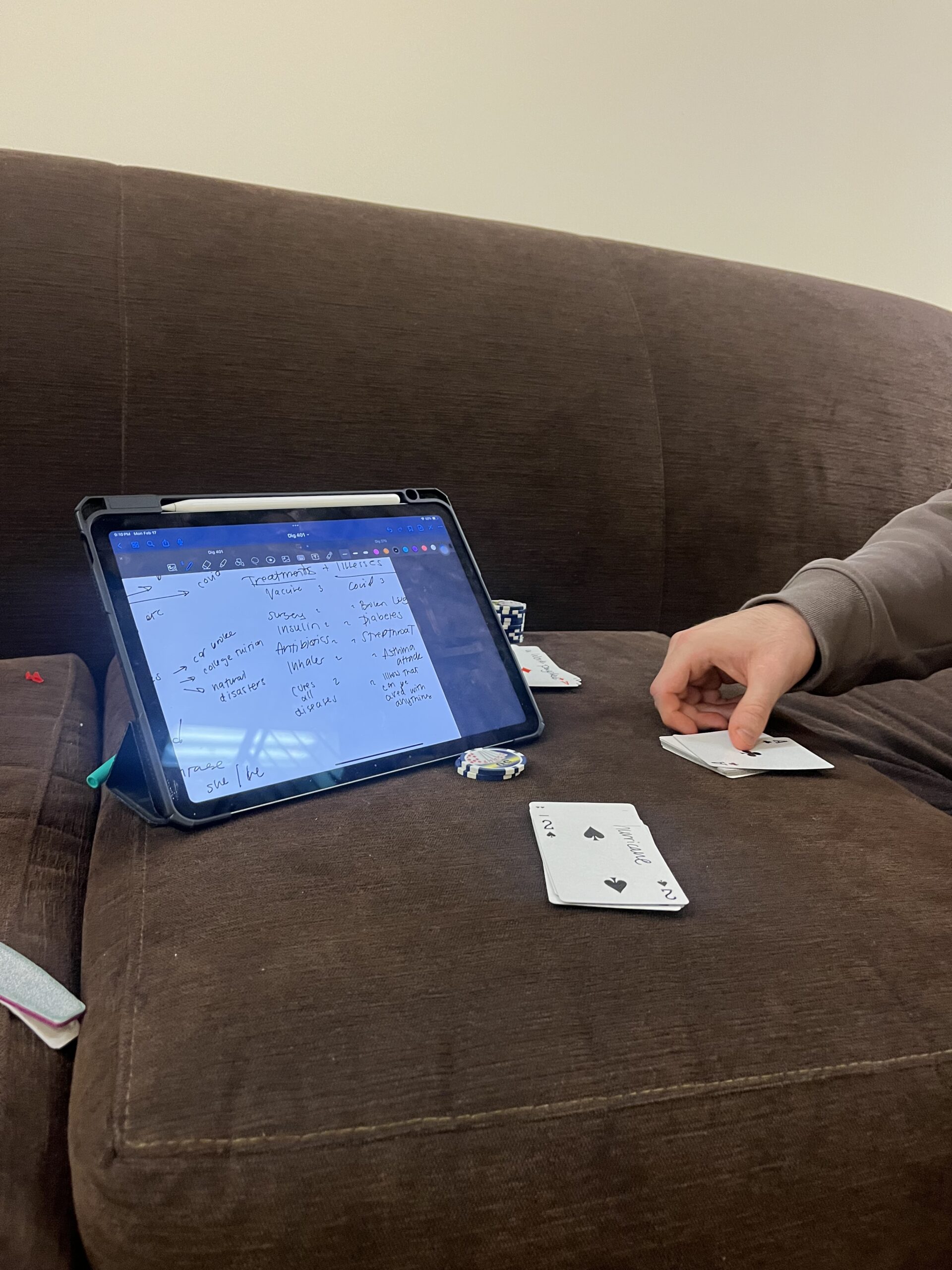
This is a two-player game, with each player taking on the role of either the insured player or the uninsured player, reflecting the real world. Both players start with five random cards and ten tokens, or chips, representing money. However, the uninsured player is at a significant disadvantage. When a player successfully matches an illness (♥) with its treatment (♣), the insured player only pays one token to the bank, while the uninsured player must pay three tokens.
In addition to illnesses and treatments, the deck contains good luck (♦) and bad luck (♠) cards, which affect each player’s financial situation. Good luck cards allow players to gain tokens, offering just a small financial relief. Examples include: “Job raise! Gain 1 token” or “You receive financial aid for your child’s college—gain 1 token,” representing financial stability that allows players to focus on treating illnesses. Bad luck cards, on the opposite side, take away tokens, reflecting the unpredictability of life. Examples include: “Hurricane—pay 1 token” or “Car crash—pay 1 token,” highlighting real-world emergencies that create unexpected financial burdens.
There is also one special good luck card that is highly valuable: “You won the lottery! Gain 3 tokens!” Because this card is a game-changer, both the insured and uninsured players are actively searching for it in the deck. To keep things simple, players must immediately pay or gain their tokens as soon as they draw a card, ensuring that no one forgets to do so later.
Once you understand these rules, playing Go Fix is just like playing Go Fish. Players take turns asking their opponent for a specific card in hopes of forming a match. For example, one might ask: “Do you have the vaccine to treat COVID?” or “Do you have antibiotics for strep throat?” If your opponent has the requested card, they must give it to you; if not, they say “Go Fix” and you must draw from the deck. However, pairs only work if they match the correct illness and treatment. Some of the correct pairs include:
- COVID-19 = Vaccine
- Strep Throat = Antibiotics
- Diabetes = Insulin
- Broken Bone = Surgery
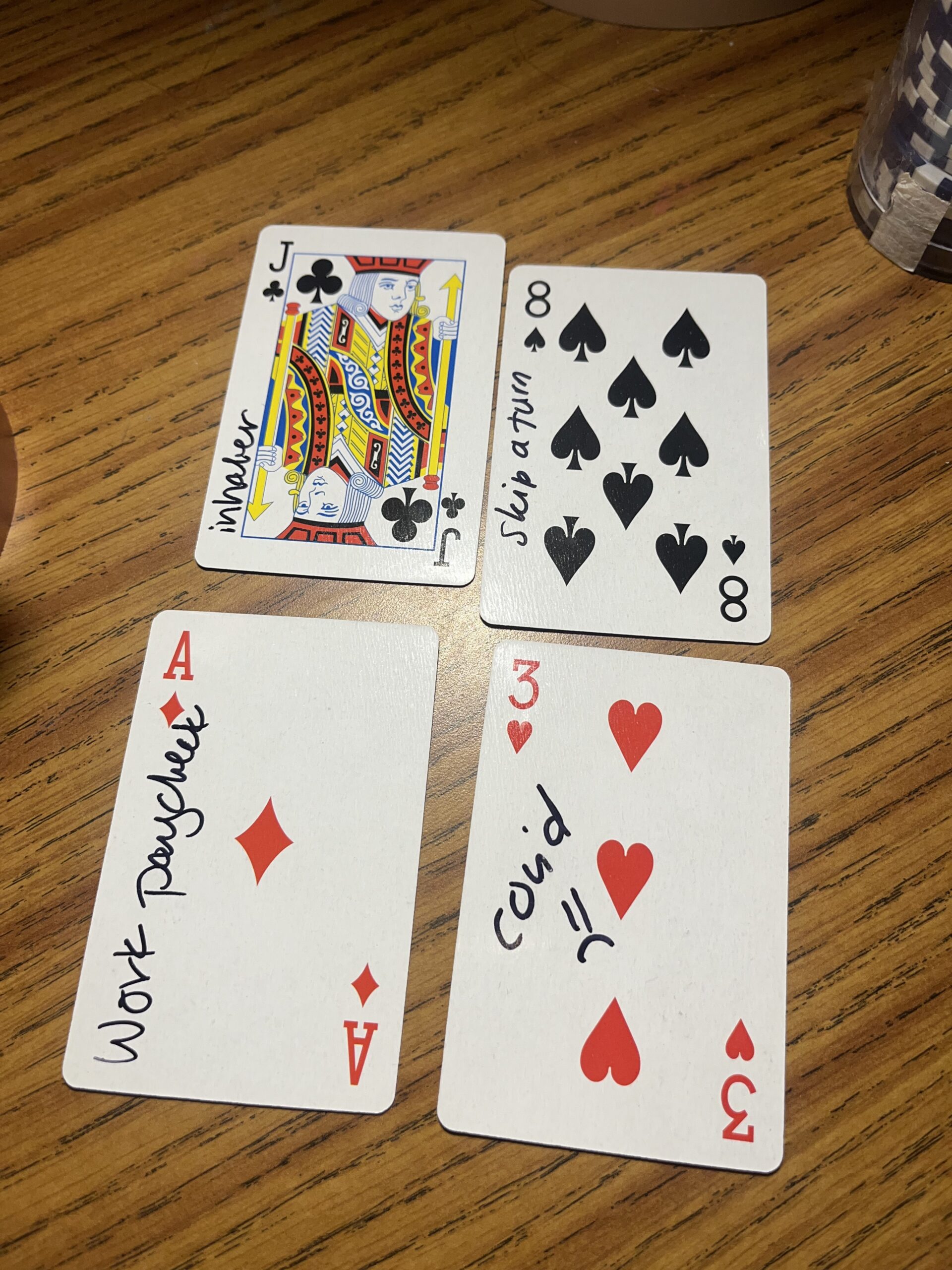
This modification also extends the game’s duration, since the chances of drawing an illness (♥) or treatment (♣) card are only 1 in 4, making it more challenging to form matches. The first player to match three illnesses with treatments wins!
As I mentioned in class, one of the most shocking things to me was the complexity of the U.S. healthcare system. During my first year here, I got really sick, and accessing good doctors and adequate care was extremely difficult. It felt as if the system was intentionally complicated and inaccessible, designed so that only the “smartest” and “richest” people could navigate it successfully. Fortunately, I had insurance provided by my college, but this experience made me consider what it would be like for those without insurance. Access to quality healthcare and the ability to live a healthy life should be a right, yet, as an outsider and international student, it seems that everything in the United States is political.
A good example of this is when Brett and I were testing our game. Even though I was the insured player, I ended the game with fewer tokens but was still able to match three pairs of illnesses with their treatments. We debated whether the winner should be the player with the most money or the player who successfully treated their illnesses. Ultimately, we decided that the winner should be the player who treated more illnesses because, in reality, what is the point of being rich if you can’t access healthcare and cure yourself?
With that being said, this version of Go Fish engages with both of Flanagan’s concepts: subversion and intervention. Firstly, let’s start with subversion. As Flanagan defines it, “an action, plan, or activity intended to undermine an institution, event, or object” (Flanagan 10), our Go Fix game challenges and exposes the harsh realities of the U.S. healthcare system. By making it harder for the uninsured player to win, the game mirrors how financial barriers often determine a person’s ability to receive adequate medical care. It forces players to confront the unfair structure of healthcare access, revealing that success in the game, just like in real life, is not purely based on skill but on pre-existing advantages like insurance coverage.
A clear example of this occurred when Brett and I found ourselves questioning who the real winner was during our test run. Was it the player who had the most money left? Or the player who successfully treated their illnesses? The fact that we even had to debate this reflects the real-world uncertainty and unfairness of the healthcare system. In reality, financial wealth does not always guarantee survival if someone cannot access or afford treatment. Our final decision, that the winner should be the player who successfully treated their illnesses, was a direct critique of the system, challenging the idea that financial stability alone ensures good health. This moment of uncertainty reinforced the broken and unpredictable nature of the system we were trying to represent, making Go Fix a subversive tool for revealing these injustices through play.
Additionally, Flanagan’s definition of intervention aligns with our work in this Hack, as she defines it as “a ‘stepping in’ or interfering in any affair, so as to affect its course or issue” (Flanagan 11). We are intervening by immersing ourselves in a system that is inherently unfair. Reflecting on my own experience, when I got sick during my first semester, I was fortunate to have insurance that covered all my expenses. However, even with that safety net, navigating the healthcare system was a stressful and uncertain process. There were so many unknowns—waiting for approvals, dealing with unclear costs, and the overwhelming complexity of the system. If this experience was stressful for someone with insurance, I can only imagine how much worse it would have been without it.
One thing I now realize is that I should have switched roles with Brett at some point while testing the game. I always played the insured player, which gave me an advantage, but it also limited my perspective. If I had experienced the game from the perspective of the uninsured player, I would have gained a deeper understanding of just how unfair the system truly is. This realization directly connects to Sicart’s idea of cognitive friction, where players expect a familiar experience but are instead confronted with unexpected challenges and systemic inequalities.
(This is a link to watch the videos of us playing! They were too heavy to upload them to this blog: https://drive.google.com/drive/folders/1xuB8uJL2FIf_ysWn-f8VqxNcV-D5rGrt?usp=drive_link)
In Go Fix, we are used to the standard rules of Go Fish, where every player has an equal chance of winning. But here, the unfairness is already part of the rules—no matter how well the uninsured player strategizes, they always face higher risks. Even if a player gets the “You won the lottery!” good luck card, it only provides temporary relief.