After reading the assignment description about eight times, I was still confused. But on the ninth read, something finally clicked, and when it did, I knew I wanted to tell a story that felt more personal and urgent. Before that, I had been working on a video about how happiness is portrayed in commercials across time, from the 1950s to the present. But something about it felt off. I wasn’t connecting with it, and I realized I wasn’t putting much love into the process. It felt like I was just assembling clips into a timeline, rather than creating something meaningful and something that could make an impact, despite it being 3 – 5 minutes long.
Not many people know this, but I come from one of the most underrepresented countries in South America — and some might even say, in the world. I’m from Bolivia. It’s a place full of breathtaking landscapes, deep cultural roots, and resilient and joyful people, yet it’s often overlooked on the global stage. Being an international student in the United States often feels like being invisible. It’s not necessarily anyone’s fault; it’s natural for a country to prioritize its own interests and narratives. But it’s difficult when the media rarely acknowledges where you come from, unless it’s to cover something controversial, chaotic, or tied to a crisis. In most global conversations, Bolivia simply doesn’t appear. Decades ago, Bolivia maintained stronger diplomatic and economic ties with the United States. But in recent years, those connections have weakened. Now, our international relationships are more closely associated with governments like China and Venezuela — alliances that, to many in the West, carry connotations of corruption, authoritarianism, and instability. Because of that, Bolivia is often dismissed or ignored, viewed as lacking strategic value or global importance. This silence, this absence, is part of what inspired me to create the remix I did. For this assignment, I chose to raise my voice and bring attention to what’s happening in my country. I knew I had the opportunity, however small, to make Bolivia visible in a space where it usually isn’t. Even if only twelve people in a classroom watch my video, it matters. It’s my way of adding a small grain of sand — of contributing something honest and meaningful for Bolivia, of making sure my country is not forgotten, at least not in this difficult moment for everyone living there. I strongly believe that using this topic for my remix perfectly encapsulates the “undiscovered public knowledge” criteria for the Hack.
My project is titled “Beautiful Bolivia, Broken Reality.” This remix weaves together a series of video clips that highlight the natural wonders and beauty that Bolivia has to offer. From the world’s largest salt flat in Uyuni to the tall, green palm trees of Santa Cruz, my hometown, these images from the heart of the first part of the remix. I found the HD footage in a YouTube video titled “Bolivia’s Diverse Landscapes: From the Andes to the Amazon,” and I carefully selected and cropped the clips that I felt best represented the Bolivia I know and love. To give the remix a modern and relatable twist, I added the song Sail by AWOLNATION. This song is widely used on TikTok today to accompany aesthetic and dramatic landscape edits, which made it a fitting choice to draw the viewer in and give the project a visually engaging, contemporary feel. The combination of stunning visuals and a familiar soundtrack helps create a strong emotional connection before the tone of the remix shifts to something much more serious.
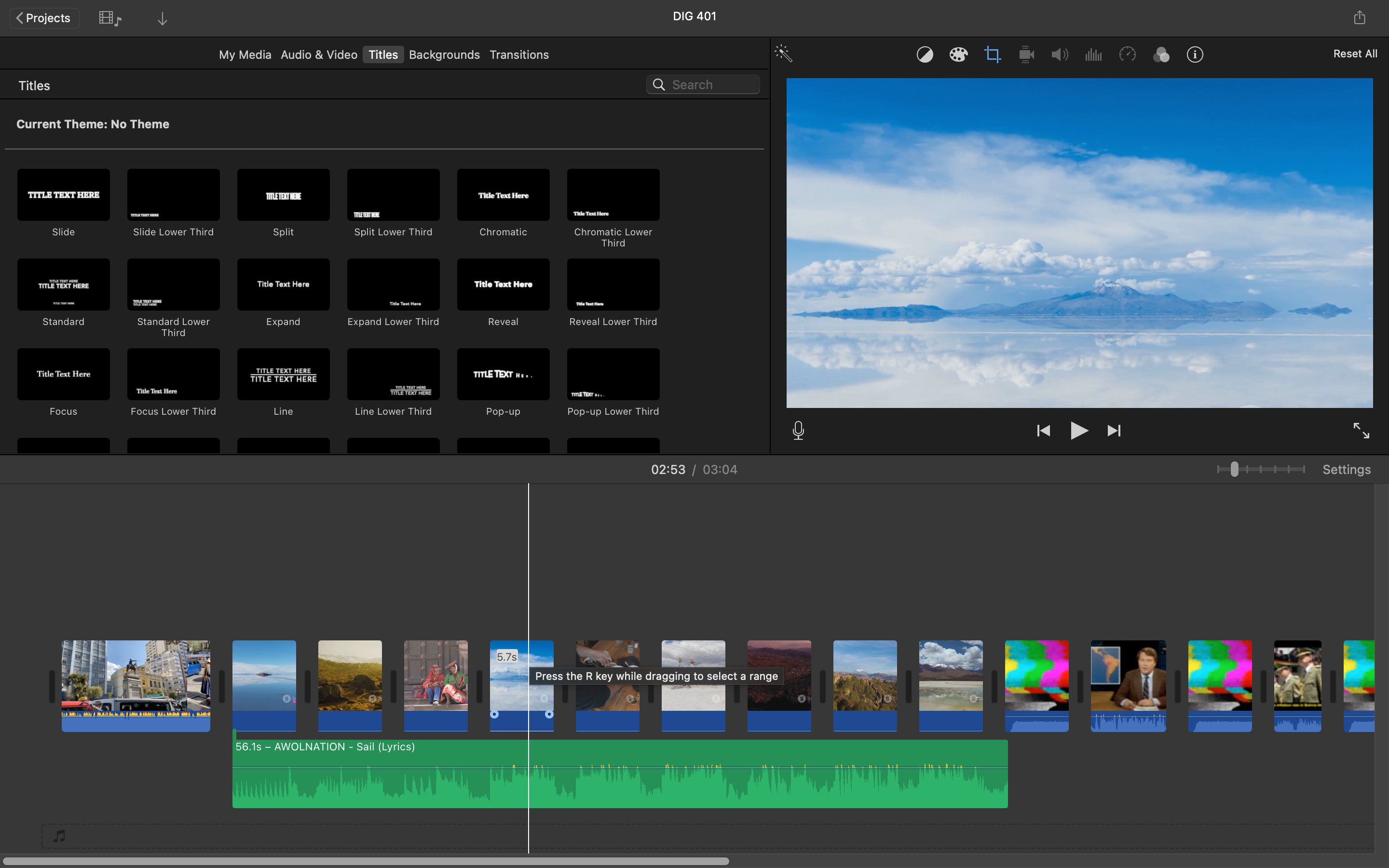
After showing Bolivia’s most beautiful landscapes, the remix suddenly shifts. The loud emergency TV beep, probably one of the most annoying sounds on the internet, breaks the calm. This sound signals that something is wrong. In this case, I’m using it to interrupt the beauty with reality. Immediately after, I included a video clip of a news reporter from the 1980s stating that “not even the United States can save Bolivia.” This moment is significant because, during the 1980s, Bolivia experienced one of the worst economic crises in its history. Inflation was so extreme that prices could double in a single day, and many people lost their life savings overnight. At the same time, the country went through a military coup, one of several in Bolivia’s history, where the government was taken over by force. This was a time filled with fear, chaos, and deep instability. People no longer trusted the government, and there was a widespread sense of uncertainty about the future. I chose to include this historical reference to show that Bolivia’s current crisis is not new. The patterns of economic collapse and political turmoil have happened before, and sadly, they are happening again, which is portrayed later on in the remix. To add to this context, I also included a clip featuring two former presidents, Jorge “Tuto” Quiroga and Gonzalo “Goni” Sánchez de Lozada, speaking about the effects of hyperinflation. Their facial expressions and tone reflect sadness and regret, a recognition of how deeply these crises have affected the country and its people.
Lastly, I decided to incorporate current footage of protests, open fire, and the recent failed attempt at a military coup — scenes that are genuinely frightening, especially when you’ve experienced them up close. I don’t think someone can truly understand what it feels like until they’ve lived through it firsthand. I’ve heard gunshots and explosions from just a few blocks away from my house. It’s a feeling of helplessness that stays with you. To show another side of the political reality, I included a video of what we call a cabildo — a large public gathering where people come together to express political demands and defend democracy. This particular cabildo took place at one of the most iconic landmarks in my city, and I chose to include it because I was actually there in 2019. You can see the Bolivian flag waving over a massive crowd. That moment felt powerful, and adding it to the remix gave the project a personal layer — it wasn’t just something I watched on the news, it was something I lived.
The screenshots you see near the end of the remix are the most recent pieces of media included in the project. These are real headlines and news images from the past three months. During this time, Bolivia has been facing extreme shortages of fuel, limited access to basic food items, and increasing isolation as several of our neighboring countries have begun to cut ties with us. These are not distant issues or theoretical problems; they are real, urgent, and affecting people every day. By ending the remix with this current footage, I hope to leave the viewer with a deeper understanding of what Bolivia is facing right now.
The rule I decided to break for this Hack was the requirement to include three distinct time periods. Instead, I focused on only two: the present day and the 1980s. These two eras are central to my remix: I use them to contrast Bolivia’s current struggles and beauty with one of the most historically significant periods in our country’s political history. The remix incorporates modern-day footage of Bolivia, showing both its breathtaking landscapes and the harsh realities of its ongoing crisis. Alongside that, I included a clip from the 1980s during one of the country’s many coups, a time when Bolivia was also facing extreme political and economic instability. I made this choice intentionally. I searched for archival footage from earlier time periods — such as the 1950s or 60s — but I struggled to find clips that could deliver the emotional weight or historical relevance that I was looking for. Most of what I found either lacked context or didn’t capture the feeling I wanted to evoke. In contrast, the 1980s footage I used felt striking and directly connected to the themes in my remix; it echoed the crisis Bolivia is facing today in a powerful and immediate way. Rather than forcing a third time period just to meet the rule, I chose to focus on making the two I did include as meaningful and impactful as possible.
